Availability : Out of stock
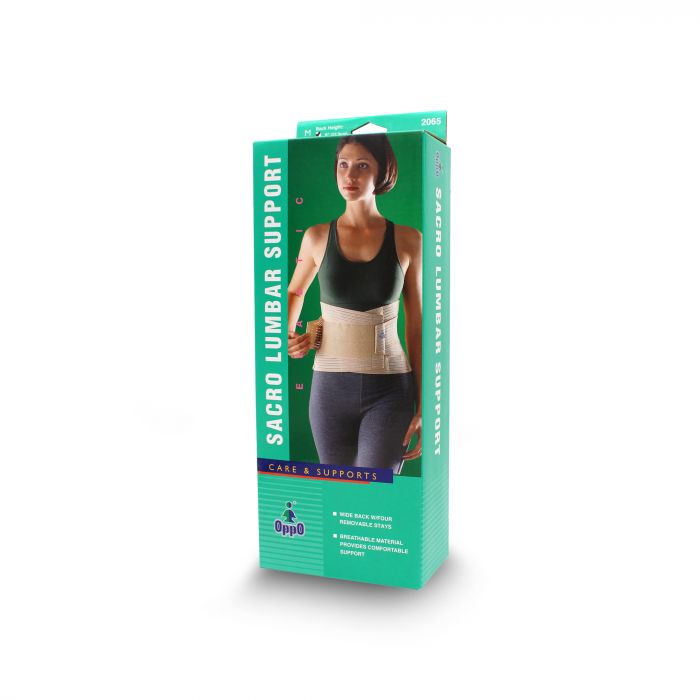
OPPO 2065-9"Application for back muscle strain and sprain, osteoporosis and low back pain.
Designed with straps crossing at the back and fastened in front.
Comfortable to wear and provides excellent support.
Four pliable support splints at the back for extra stability.
Available in 12″ (30.4cm).
"
SACRO LUMBAR SUPPORT(L)
Only 0 left
Details
"Product Features:
Designed with straps crossing at the back and fastened in front.
Comfortable to wear and provides excellent support.
4 pliable support splints at the back of extra stability.
Available in 2 back heights: 9"" (22.8cm) and 12"" (30.4cm)
How to Wear:
Wrap support around the waist and secure to desired compression and a comfortable fit.
Be sure four stays are positioned on each side of spine.
Pull side straps and secure for extra compression.
Used For:
Back muscle strain and sprain
Osteoporosis
Low back pain
The spine has three main sections, cervical, thoracic, and lumbar. There are seven cervical vertebrae (C1-C7), twelve thoracic (T1-T12), and five lumbar (L1-L5). In addition, there are two fused vertebrae, the sacrum and the coccyx. The twelve thoracic and five lumbar vertebrae make up the thoracolumbar spine. The cervical spine supports the head and allows anterior, posterior, and lateral flexion and extension, plus rotation of the head and neck. C2, called the axis, forms a pivot with C1, called the atlas, around which the head rotates on the cervical spine. Normal curvature is lordotic (eyes pointing up). The thoracolumbar spine (T1-L5) has two normal curvatures, lordotic in the lumbar region and kyphotic in the thoracic region. The primary spinal functions are to maintain an erect posture, provide stability and mobility, transmit loads, absorb shocks, and protect the spinal cord.
Added on January 06, 2015"
Delivery and Returns
Estimated between Thu. Jan. 31 and Sat. Feb. 16
Includes international tracking
Payments
Estimated between Thu. Jan. 31 and Sat. Feb. 16
Includes international tracking